
Medical students don’t fail anatomy and physiology because they’re lazy.
They struggle because the volume is brutal, the detail is unforgiving, and traditional study methods collapse under pressure.
Automating active recall for anatomy and physiology exams is not about studying more.
It’s about converting overwhelming content into a system that works with your brain, not against it.
This guide explains how automated learning, when done correctly, can turn anatomy and physiology from memorization hell into structured, repeatable mastery.
Why Anatomy and Physiology Break Traditional Study Methods
Anatomy and physiology are different from most subjects.
They demand precision, integration, and long-term retention.
The Volume Problem
Medical students are expected to memorize:
- Hundreds of anatomical structures
- Physiological pathways
- Hormonal feedback loops
- Clinical correlations
Rereading notes does not scale to this level of complexity.
The Illusion of Understanding
Highlighting and passive review feel productive.
They create familiarity, not recall.
This illusion collapses during exams when recognition fails to convert into retrieval.
Time Is the Real Constraint
Medical students don’t lack motivation.
They lack hours.
Any strategy that increases workload without increasing efficiency is dead on arrival.
What Active Recall Actually Is (And What It Isn’t)
Before automation matters, clarity matters.
Active Recall is the process of retrieving information from memory without cues.
It forces the brain to work, strengthening neural pathways.
Active Recall Is:
- Testing yourself before reviewing
- Answering questions without looking
- Explaining concepts from memory
Active Recall Is Not:
- Rereading slides
- Watching videos passively
- Highlighting textbooks
The science is clear.
Retrieval practice outperforms passive study across disciplines.
A large review published in Psychological Science in the Public Interest confirms that active recall dramatically improves long-term retention compared to repeated study.
Why Anatomy and Physiology Need Automation
Active recall works.
But manual active recall breaks down at medical scale.
Manual Flashcards Don’t Scale
Creating quality flashcards for:
- Every nerve
- Every muscle action
- Every physiological mechanism
…can take longer than studying itself.
Students burn out before the system pays off.
Consistency Is the Bottleneck
Spaced Repetition only works if reviews happen on schedule.
Miss a few days, and the system collapses.
Medical life is not predictable enough to rely on perfect discipline.
Integration Is Often Missing
Manual systems fragment knowledge.
Anatomy becomes disconnected from physiology, and physiology from clinical relevance.
Automation fixes these problems.
Automating Active Recall for Anatomy and Physiology Exams Explained
Automated Learning uses AI systems to handle the heavy lifting while preserving cognitive science principles.
You still do the thinking.
The system handles the structure.
What Automation Actually Automates
Automation does not replace learning.
It replaces friction.
Specifically, it automates:
- Flashcard creation
- Question formatting
- Review scheduling
- Concept linking
This is where AI-generated flashcards outperform traditional tools.
How AI-Generated Flashcards Transform Anatomy Study
Anatomy is visual, spatial, and relational.
Poor flashcards destroy context.
Intelligent Question Design
AI-generated flashcards can:
- Ask structure → function
- Ask function → structure
- Test relationships, not isolated facts
This mirrors how anatomy is tested clinically.
Multi-Angle Recall
Instead of one card per structure, automation creates:
- Identification questions
- Functional questions
- Clinical application prompts
This prevents brittle memorization.
Image-Integrated Recall
High-quality systems pair questions with labeled or partially masked diagrams.
This is critical for:
- Vascular pathways
- Neuroanatomy
- Musculoskeletal systems
Automating Active Recall for Anatomy and Physiology Exams at Scale
This is where automation stops being convenient and starts being necessary.
Physiology Is About Processes, Not Facts
Physiology exams test:
- Sequences
- Feedback loops
- Cause-and-effect chains
Automation allows flashcards that:
- Build stepwise reasoning
- Test pathway disruptions
- Reinforce dynamic understanding
Concept-to-Question Pipelines
Advanced systems can convert:
- Lecture slides
- Video transcripts
- Textbook sections
Into structured recall prompts automatically.
This eliminates hours of manual card creation.
How AI-Generated Flashcards Transform Anatomy Study
Anatomy is visual, spatial, and relational.
Poor flashcards destroy context.
For students deciding where to apply these principles, a comparison of the best AI flashcard apps for medical students shows how different tools handle automated active recall in real exam scenarios.
Intelligent Question Design
AI-generated flashcards can:
- Ask structure → function
- Ask function → structure
- Test relationships, not isolated facts
This mirrors how anatomy is tested clinically.
Multi-Angle Recall
Instead of one card per structure, automation creates:
- Identification questions
- Functional questions
- Clinical application prompts
This prevents brittle memorization.
Image-Integrated Recall
High-quality systems pair questions with labeled or partially masked diagrams.
This is critical for:
- Neuroanatomy
- Musculoskeletal systems
- Vascular pathways
The Role of Spaced Repetition in Medical Retention
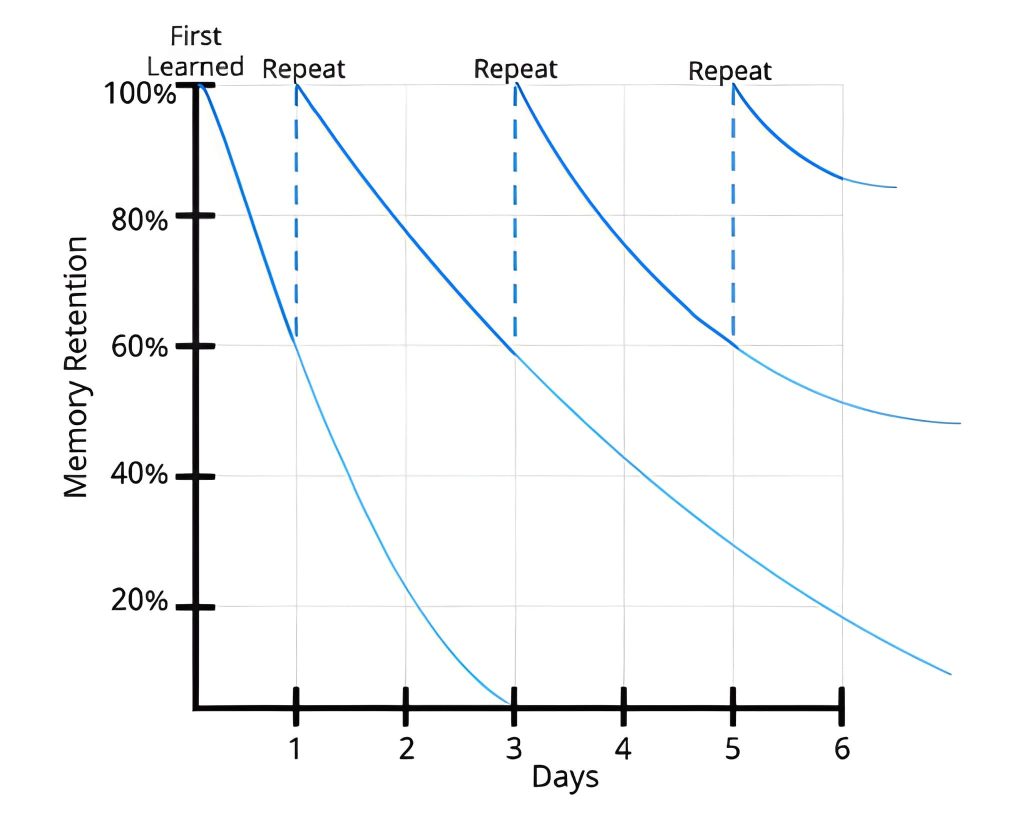
Spaced Repetition is not optional for long-term medical learning.
It is foundational.
Why Spacing Works
Spacing forces the brain to retrieve information just before forgetting.
This strengthens memory traces efficiently.
NIH-supported research shows that spaced learning significantly improves retention across complex domains.
Why Automation Matters Here
Manual spacing systems rely on perfect adherence.
AI systems adapt dynamically.
They:
- Adjust intervals based on performance
- Prioritize weak concepts
- Prevent overload during busy weeks
This keeps learning alive even during exams and rotations.
Anki for Anatomy vs Automated AI Systems
Many students ask if Anki for anatomy is enough.
The answer depends on execution.
Where Anki Excels
- Proven spaced repetition engine
- Large community decks
- Offline control
Where Anki Fails Medical Students
- Manual card creation is exhausting
- Community decks vary wildly in quality
- Little integration with physiology workflows
AI-powered systems build on Anki’s strengths while removing its biggest pain points.
Physiology Study Hacks That Actually Work
Automation is only effective when paired with good strategy.
Focus on Mechanisms First
Memorize:
- Why a process happens
- What changes when it fails
Then layer in details.
Use Bidirectional Recall
Always test:
- Cause → effect
- Effect → cause
This mirrors exam logic.
Avoid Isolated Facts
Automated systems shine when they connect:
- Hormones to organs
- Signals to responses
- Anatomy to physiology
Disconnected facts decay quickly.
Why Video-to-Flashcard Automation Is a Game Changer
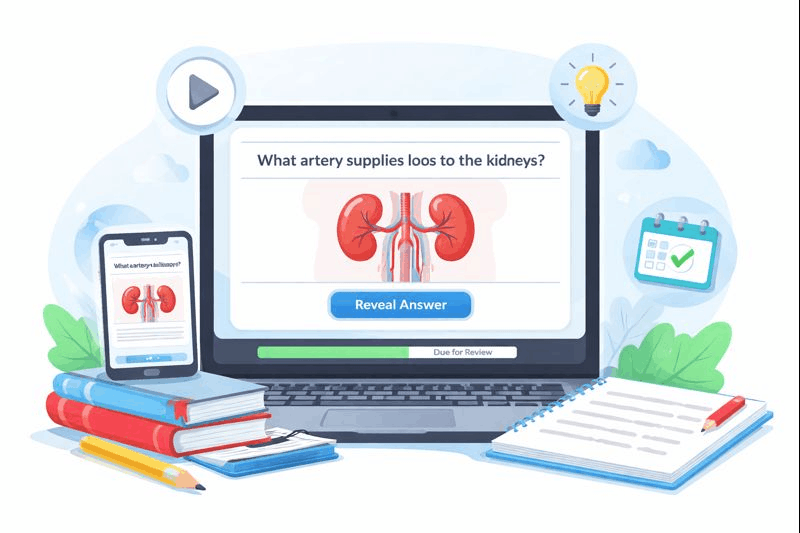
Medical education is increasingly video-based.
Manual note-taking does not keep up.
From Lecture to Recall Automatically
Modern platforms can:
- Transcribe lectures
- Extract key concepts
- Generate recall prompts
This preserves attention during lectures while ensuring review-ready material later.
Eliminating Passive Watching
Videos feel productive.
They rarely are.
Automated recall forces engagement after viewing, where learning actually happens.
Evidence-Based Learning, Not Study Myths
FlashLearnAI’s philosophy aligns with cognitive science, not trends.
Retrieval Beats Repetition
Repeated exposure without recall leads to rapid forgetting.
Desirable Difficulty Matters
Struggle during recall strengthens learning.
Automation preserves difficulty while removing busywork.
Human Editing Still Matters
The best systems combine:
- AI efficiency
- Human oversight
- Evidence-based structure
This avoids shallow or misleading questions.
Common Mistakes Students Make When Automating Study
Automation is powerful, but misuse kills results.
Overloading the System
Too many cards per day leads to burnout.
Quality beats quantity.
Ignoring Weak Areas
Students often avoid difficult cards.
Good systems force confrontation.
Treating Automation as Passive
Automation supports effort.
It does not replace it.
How FlashLearnAI Approaches Automated Learning Differently
FlashLearnAI is built for serious learners, not productivity theater.
Medical-Grade Content Standards
Every workflow prioritizes:
- Accuracy
- Clinical relevance
- Cognitive load control
Anatomy and Physiology First
This platform is designed around:
- High-volume memorization
- Process-heavy subjects
- Exam-driven outcomes
Built for Trust, Not Tricks
No gamification gimmicks.
No dopamine loops.
Just structured learning that compounds
Who Benefits Most From Automating Active Recall
This approach is ideal for:
- Medical students
- Nursing students
- Pre-med and allied health learners
- Lifelong learners revisiting core sciences
If retention matters more than short-term cramming, automation pays off.
What to Expect After 4–6 Weeks of Proper Automation
Results are not instant.
They are durable.
Students typically report:
- Faster recall during exams
- Reduced pre-exam anxiety
- Less time spent relearning forgotten material
The system starts working for you instead of demanding constant attention.
Is active recall really effective for anatomy and physiology exams?
Yes. Active recall forces retrieval of complex structures and processes, which strengthens long-term memory far more effectively than rereading or passive review. This is especially important for anatomy and physiology, where recognition alone is not enough in exams.
How does automating active recall help medical students save time?
Automation removes the manual work of creating flashcards, scheduling reviews, and formatting questions. This allows students to spend their limited time on actual recall and understanding rather than administrative study tasks
Can AI-generated flashcards replace traditional anatomy textbooks?
No. AI-generated flashcards are a supplement, not a replacement. They work best when built from high-quality sources like textbooks, lectures, and clinical materials, turning that content into effective recall prompts.
Is spaced repetition necessary for mastering physiology concepts?
Yes. Physiology relies on understanding interconnected processes over time. Spaced repetition ensures these concepts are revisited at optimal intervals, preventing rapid forgetting and improving exam-day recall.
Who benefits most from automating active recall for anatomy and physiology exams?
Medical, nursing, and allied health students benefit the most, especially those managing heavy workloads and dense curricula. Anyone studying high-volume, detail-heavy biological sciences will see clear advantages.
Bottom Line: Mastery Requires Systems, Not Willpower
Anatomy and physiology don’t reward effort alone.
They reward structure.
Automating active recall for anatomy and physiology exams transforms learning from a daily fight into a controlled process.
When Active Recall, Spaced Repetition, and Automated Learning work together, medical studying stops being overwhelming and starts becoming predictable.
That predictability is what top performers quietly rely on.
And it’s exactly what FlashLearnAI is built to deliver.